3 High/3 Low Metrics Framework
The 3 High/3 Low framework includes the next six metrics you should be tracking after MRR and growth, and you want to push three of them upward (i.e., high) and three of them downward (i.e., low).
We’ll start with the three Low Metrics.
LOW: Cost to Acquire a Customer (CAC)
In its simplest form, CAC is all the costs associated with landing new customers (e.g., marketing, advertising, sales) divided by the number of customers you acquired during that period.
It’s sometimes tricky to calculate because getting a handle on your marketing costs can be tricky. If you’re focusing on SEO, you may be creating all the content yourself rather than paying a writer. You may be getting a lot of your early customers from forums you spend time on or by getting in front of other people’s audiences. In those cases, the cost is your time rather than an easy-to-calculate number.
It’s a lot simpler to calculate CAC if you’re running ads. Then, you can see how much you’re paying per click and track how many people convert from each source.
But if you’re not in that position, valuing your time at a certain rate (e.g., $150 an hour) and taking your best guess at time and money spent on marketing in a given month can get you to a good enough estimate of your CAC.
How do you know if your CAC is too high? By calculating how long it’ll take to pay back the costs of acquiring each customer.
As I was first getting into recurring revenue, I thought that if I was getting $1,000 in LTV from each customer, I could spend $700 to acquire every customer and make $300 a pop. Right?
The problem is that you’re not getting $1,000 every time you sign a new customer. With a $50-a-month contract, you’re getting that $1,000 over the course of the next year and a half.
If you spend $700 per new customer in January, you won’t break even on those customer acquisition costs until next February (assuming the customer doesn’t churn).
With venture capital, the rule of thumb is that you should spend no more than one-third of your customer’s LTV or no more than one ACV.
As bootstrappers, we don’t have enough cash to wait 12 months to recoup CAC from every customer. Most successful bootstrappers I know are in the two- to six-month payback period (depending on how much cash they have in the bank).
There are times when that number can get more aggressive. For example, at our peak with Drip, we could afford to spend more on customer acquisition because we had the cash in the bank and I knew the numbers in the rest of our funnel by heart. Even at our peak, though, we were only running seven or eight months out—that’s the high end for bootstrapped companies.
LOW: Sales Effort
Sales effort is a measure of the length of your sales cycle and includes the number of touch points required to make the sale. Where CAC measures the amount of money you’re spending to get a new customer, sales effort measures the time and energy you’re spending.
The best way to track sales effort is to look at both the average number of days from someone scheduling their first demo to closing and the number of calls it takes to close a deal.
Your ability to keep sales effort low depends greatly on your industry and customer base.
If you’re doing enterprise sales, your sales cycle will be long and require more effort than if you’re targeting solopreneurs and other small businesses with a single decision-maker. A three- or four-month sales cycle is reasonable in enterprise sales—and worth it because the ACV might be $50,000. If you’re spending that much time for $5,000 contracts, though, that’s rough.
No matter what your sales process looks like, you want your sales effort to be as low as possible. Here are some ways to lower this number.
Self-Serve Sign-up and Onboarding. Many inexpensive products can get away with low price points because they have a low-touch or no-touch sales process. They have a self-serve sign-up and onboarding process, which requires almost no sales effort.
The higher your ARPA, the less likely they are to become customers without some sales effort. But finding places to offer self-service along the journey can reduce the amount of hand-holding your team has to do while making the process speedier for your customer.
One-Call Close. Self-service isn’t going to work in a lot of spaces, but you can try to get to a point where the decision is made by a single person. You can do this by targeting a founder, a developer, or a single manager.
You can also streamline the back-and-forth of providing more sales materials, getting on second calls, waiting for input from the committee—and on and on.
Educate your customers as much as you can ahead of time so they have the information they need and develop checklists to gather the information you need to close the deal quickly.
LOW: Churn
Churn is the percentage of people canceling their subscription each month, and it’s the Achilles heel that kills (or plateaus) SaaS apps. If you can keep churn low, growth is much easier. If churn is high, it’s a force that’s very hard to outrun.
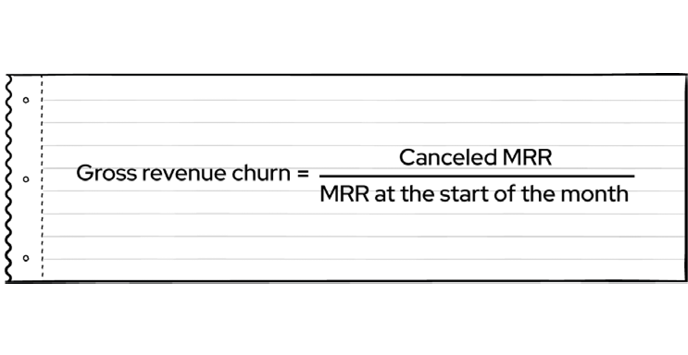
Focus on revenue churn. To calculate this, divide the gross MRR that canceled in a given month by the starting MRR for that month:
As a general rule, for most bootstrapped B2B SaaS businesses:
- Gross churn > 10% = Catastrophic
- Gross churn 8–10% = Not Good
- Gross churn 6–7% = Meh
- Gross churn 4–5% = Fine
- Gross churn 2–3% = Good
- Gross churn < 2% = Great
With this caveat: if you are focused on high-priced contracts, say, above $25,000, your churn should be lower than the chart above. In that case, I’d categorize fine churn as 2–3%, good churn as 1–2%, and great churn at or below 1%.
Churn is such a critical metric because it helps you calculate when revenue will plateau.
At some point, the number of new customers you acquire will equal the number of customers you churn out each month. This causes your growth rate to effectively hit zero. You’ve hit your maximum number of customers (and revenue) that you can achieve without changing something in the business.
It’s a simple calculation:
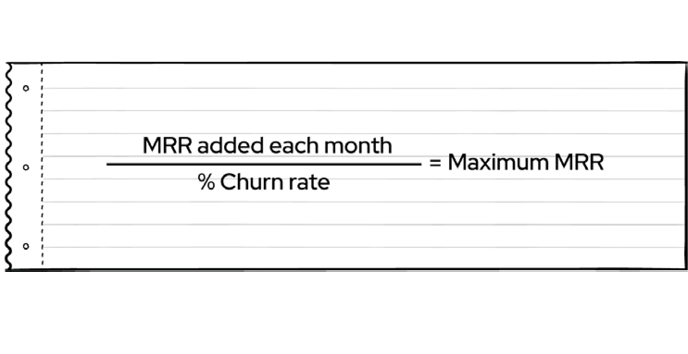
If you acquire $5,000 in new MRR each month and have a churn rate of 10%, that’s 5,000/0.10 = $50,000. If you don’t change something in your business, you will plateau at $50,000 in MRR.
This plateau number should strike fear in your heart because SaaS plateaus are brutal. They are often difficult to fix, as they might require a strategic overhaul of your product, customer focus, or marketing approaches.
I recommend every SaaS founder calculate their plateau number. You could feasibly have a dashboard that calculates it in real time. It gives you a window into the future and lets you start troubleshooting early to push that plateau further out.
Churn is such a critical metric that we’ll dive deeper into it in the next section.
HIGH: Annual Contract Value (ACV)
ACV is the amount a SaaS customer will pay if they stick around for a year, whether you offer a yearly plan or calculate it based on 12 months of your monthly subscription cost.
A lot of SaaS resources will point you to tracking LTV, but ACV is actually the more valuable metric for SaaS bootstrappers. Here’s why.
The simplest equation for LTV is your ARPA divided by your churn. For example, if you’re getting $50 a month from a customer and have 5% churn, your average LTV for each customer is $1,000.
This is far from a perfect formula, but it’s the simplest one to get insight into your LTV.
Let’s say you lower that churn to 1%, which makes your LTV $5,000. Pretty good, right? Except that you’ll be getting that five grand over the next eight years. If you have millions in venture capital in the bank, maybe you can afford to wait a while to recoup your costs, but as a bootstrapper, you need to be thinking shorter term.
That’s why I recommend you stay focused on ACV as a key metric rather than LTV.
One of the biggest ways to keep your ACV high is to sell to businesses rather than consumers—usually the larger the business, the more they can pay (though that depends on the problem your product solves). This metric in particular is usually in tension with CAC and sales effort because selling to more significant customers requires more sales effort, which is naturally more expensive.
You can also increase ACV by raising prices, which we covered in-depth in the Pricing chapter.
HIGH: Expansion Revenue
We discussed this in the Pricing chapter, but as a refresher, expansion revenue is when customers pay you more as they get more value from your product. Whether by manually upgrading to the next tier or being auto-upgraded as their usage increases.
You can increase expansion revenue by having pricing tiers that ensure the more value a customer gets out of your product, the more they pay. That can be through value metrics (like adding seats in a CRM or subscribers in an email services provider), feature gating, or both.
When your expansion revenue is high enough, you can actually get to the point where your revenue is growing even when you’re not adding any new customers. That’s what makes expansion revenue an incredible SaaS Cheat Code.
HIGH: Referrals
The last critical SaaS metric is referrals, or how many new customers were referred by your existing ones. Referrals are a good metric to monitor because it is less of a lagging indicator than most.
When your referral per customer is high, the natural flywheel of virality starts to spin. Over time, word of mouth can become a big driver of new customers—and certainly one of your highest-converting drivers. Referred customers have substantial conversion rates and take a lot less sales effort because they’re already inclined to trust your product.
The best way I’ve seen for determining how many referrals you’re receiving is to ask how a customer heard about you at their point of sign-up.
Asking for Referrals. Not every product can have word of mouth baked into the product, but every founder can—and should—be proactive about asking for referrals.
When you see that trials are converting well and customers are happy with your product, set up an automated email that goes out around the 60- or 90-day mark. Say something like, “So much of our business is based on referrals. If you’re enjoying our product, could you please pass the word along?”
The automated email works well when you have a pretty hands-off, low-touch sales process. However, for products with higher ACVs and a more intensive sales process, it’s better to ask for referrals in person.