Marketing Funnels
A marketing funnel describes the stages of your customers’ journey from the moment they learn about your business to the point at which they become paying customers.
The most common marketing funnels in SaaS are high-touch, low-touch, and dual. Which one is right for your product? That depends on your market, pricing, and customer base.
As Aaron Kassover, founder of AgentMethods, told me: “It seems like most SaaS founders want to go low-touch because that’s what we prefer as customers. We hate having to talk to a salesperson before getting our hands on a product. But most markets prefer high-touch. Switching from low- to high-touch was really hard for me because it wasn’t what I wanted, but it’s what propelled us to product-market fit. How you sell is as important as what you sell.”.
High-Touch Funnel
A high-touch funnel gives your customers a lot of human interaction as they make their buying decision.
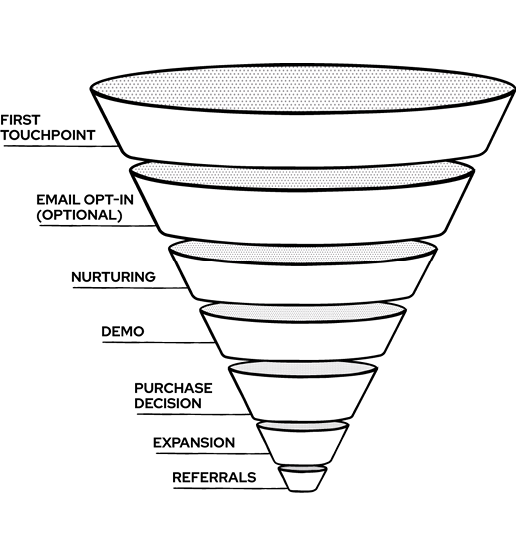
For example, a prospect might first become aware of your product because they stopped by your booth at a trade show and met with you or a member of your sales team. They volunteer their contact info and become a lead.
Leads aren’t necessarily going to buy anything. They might have just been interested in the whitepaper or webinar you were offering. A lead becomes an opportunity when they express interest in your product.
For example, when someone from your sales team follows up with an offer to jump on a sales demo, they say yes. If the demo goes smoothly, that opportunity might sign up to become a new customer, who usually gets passed to a customer success representative to set up their account.
Obviously, the higher touch your marketing funnel is, the more money you need to make from each customer. High-touch funnels work best for companies that charge a minimum of $500 a month and focus on customers who can afford that price point.
Higher-touch funnels also tend to focus more on outbound marketing tactics like cold-calling, cold-emailing, and LinkedIn outreach.
The percentage of conversions you’ll have with a high-touch funnel will vary depending on your industry and pricing. A product with a $100,000 annual contract value (ACV) will have a very different close rate than a product with a $3,000 ACV.
You can do a lot to improve your funnel metrics by bringing in qualified leads, educating them before they become opportunities, and closing the sale during demos. In the pre-acquisition days of Drip, we had a close rate of 25% to 35% from demo to customer, and most were one-call closes.
Low-Touch Funnel
A low-touch or no-touch funnel works when you have a wide market and a low-priced product.
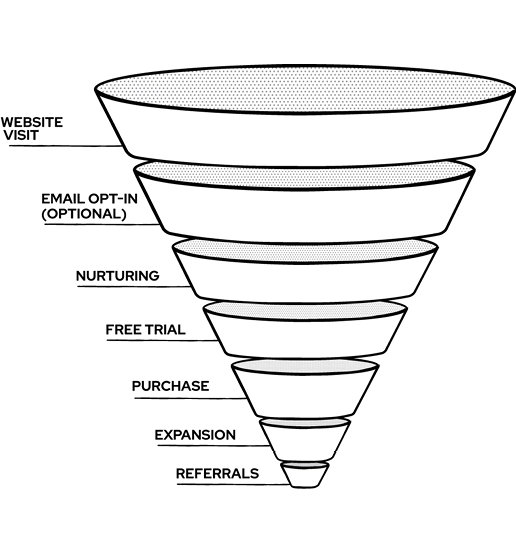
In this model, you set up a large funnel where leads come in on their own and are led automatically through a sales process without much input from you or your team.
For example, your prospects become aware of your image-editing app through ads on Facebook and sign up for your free seven-day trial without talking to someone on your team. After the trial is up, some percentage automatically converts to customers on your $19-a-month paid tier.
Imagine your basic sales funnel:
- You drive traffic through content marketing, SEO, appearing on a podcast, etc.
- They hit your website to check out your product.
- They sign up for a trial or request a demo.
- They use your software during a trial period, then convert to paying customers.
- They stick around as happy, satisfied customers.
- They eventually upgrade their account or refer additional people to your product.
Because you’re not spending as much energy qualifying leads, you’ll see lower conversion rates and usually higher churn—but because your low-touch funnel doesn’t require as much hand-holding, your cost to acquire a customer and the cost to sell to that customer are very low.
A low-touch funnel tends to be a volume game. It is highly focused on inbound marketing tactics like SEO, PPC ads, content marketing, and influencer marketing.

Rules of thumb for funnel metrics change over time, so instead of including them here I have a page on this book’s companion website where you can see my most up-to-date numbers: saasplaybook.com
