How Can I Avoid Burnout?
In 2015, as I was riding the rocketship of Drip, I started to burn out.
As the founder, I was bearing the burden of every task that slipped through the rest of the team. I managed legal, HR, payroll, operations, business development, and marketing; I co-led product and engineering; and I ordered snacks for the office. These were all things the company needed, and I was fully capable of doing them. A few of them brought me joy.
Every month I asked myself how I could hire someone to do all of the above. But being cash-strapped in a hypercompetitive space meant that shipping more features felt more important than finding someone to handle day-to-day business tasks.
Some months Drip grew enough to warrant hiring one or two additional full-time employees. And every time, I opted to hire in customer success, sales, or engineering. I wanted to close more deals and ship more features, my happiness be damned.
Except it began to take a toll in a serious way. My motivation slipped over the course of many months. After overcoming the prolonged financial stress of 2014, when Drip wasn’t growing quickly enough, I began to experience burnout in mid-2015. Many days I showed up to work and stared at my Trello board, unmotivated to do any tasks. Nothing on the board looked interesting.
Jason Cohen did a talk at SaaStr in 2018 that put visuals to what I experienced.
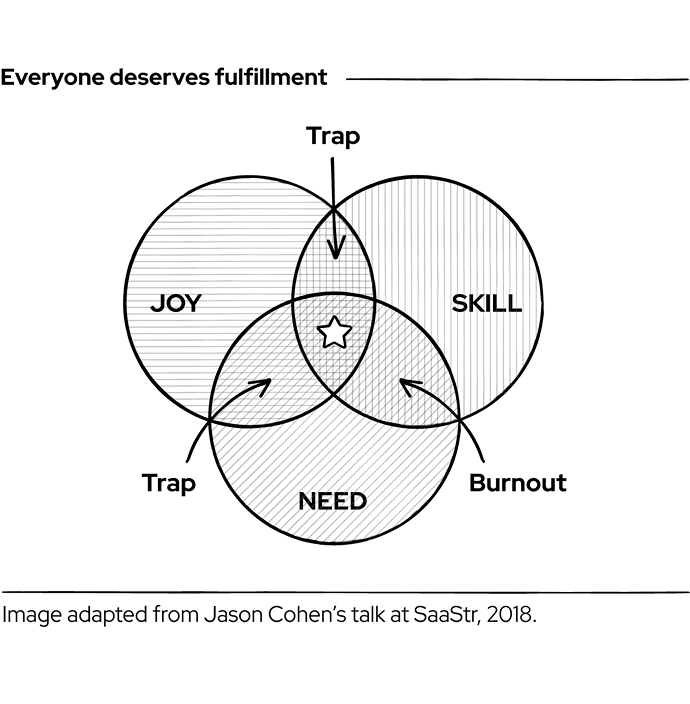
In one circle are the things you’re happy doing. In the second are the things you’re good at. And in the third are the things your company needs.
The sweet spot for your work should be where all three intersect. If you’re focusing solely on things you’re good at that bring you joy, you can get stuck galloping down paths that are detrimental to the needs of your company. If you’re doing things the company needs that bring you joy (but you’re not good at), then you’re dragging your company down.
But if you’re stuck doing things the company needs that you’re good at (but don’t like), that leads to burnout.
That’s exactly what I was doing. I hired an executive assistant who lightened that load for a bit. She helped streamline a few things and made appointments, but what I really needed was someone to whom I could delegate at another level.
At the time, I felt like we couldn’t afford someone who wasn’t contributing to the bottom line of the company. In retrospect, this was one of the biggest mistakes I made while building the company.
I should have hired someone who could come into the office and handle operations. Things like legal, payroll, HR, and facilities. Most of these were outsourced to external providers, and it was just a matter of interfacing with them.
As I look back at my descent into burnout, one thing that could have saved me was having enough funding to hire someone to do the work that didn’t bring me joy. Or prioritizing spending money on hiring and delegating tasks that didn’t move the business forward but were contributing to my lack of satisfaction at work.
I hope you’re not at a place where the next section is helpful to you. I hope that you’re smarter than I was and are putting measures into place to keep yourself from burning out like I did.
As Jason said in his talk: “The right question is what should you be doing differently now […] in order to build a company that’s more healthy and prosperous, and also avoid this balloon payment of emotional toil at the end.”
Getting through Burnout
I’ve heard burnout manifests itself differently in different people, but for me it felt like a mix of depression and frustration. Not the kind you can clear up with a weekend away, but a long-term, deep sense of tiredness, lack of motivation, and feeling just a little pissed off at all times.
This led to my aforementioned stints of staring at Trello for hours and a lack of presence at home. I would be home with the family, but most of the time my mind was elsewhere.
I tell this as a cautionary tale: if you find yourself listless, unmotivated, or constantly frustrated as you endure the stress of building your company, it’s unlikely to fix itself. The best remedy for burnout is significantly changing your habits and patterns related to work, including stepping away for weeks, which feels like the last thing you can do when everything is going crazy (whether it’s good crazy or bad crazy).
If you find yourself in this situation, you need to address it, or it will get worse. If unaddressed, burnout can lead to terrible outcomes, including long-term damage to your brain.
If burnout is a situation you find yourself in, consider reaching out to a professional who works with founders on the mental game of entrepreneurship. Dr. Sherry Walling is one (she happens to be my wife, and she knows her stuff), but there are many other executive coaches and therapists who work with high-performing individuals to manage stress, burnout, and everything else that comes with our line of work.
I’ve only started to touch on burnout here, but for an entire chapter about it, check out my third book: The Entrepreneur’s Guide to Keeping Your Sh*t Together: How to Run Your Business Without Letting it Run You.