How Do I Know Which Marketing Approaches Fit My Business?
As we saw in the previous section, there are many ways to market your product. And a big challenge we face as founders is prioritizing which approaches to try. This section discusses how to filter and prioritize marketing approaches to find the handful that are likely to work best for your business. Here’s the framework I recommend for this:
The Three Factor Framework
The three factors of a marketing approach are speed, cost, and scalability. You need to take all three into account when choosing marketing approaches.
Speed. How long does it take for a marketing approach to start returning results? Weeks? Months? Years? How long can you afford to spend money and time on a marketing approach before you start to see new customers?
In the early days, faster approaches are the key to getting initial customers. As your product matures, you can afford to spend more time cultivating slower marketing approaches.
Ideally, you should be working on a fast and a slow approach at the same time. If you focus only on fast tactics, you’ll always be chasing new leads. If you focus only on slow approaches, you’ll end up in a wasteland while you wait for your efforts to show results.
For example, you can get relatively fast results with cold outreach while building organic search results that can sustain you in the long term.
Cost. How much will it cost? In the early days, you’ll want to think in terms of hard costs—dollars and cents—instead of your own time.
The higher your ACV, the more money you’ll have to invest in marketing. As you scale your product and raise prices, you’ll notice that more marketing approaches become available.
Scalability. Can you scale this approach to reach more people?
Many marketing approaches in the low-scalability camp are either one-time events like posting to Product Hunt or require a lot of time, like answering questions on Quora.
On the other hand, if there is enough search intent for your tool and you can dial in search and PPC ads, you can often keep turning that dial up to reach more people without spending a lot more time.
Which Approach Works Best at Your Price Point?
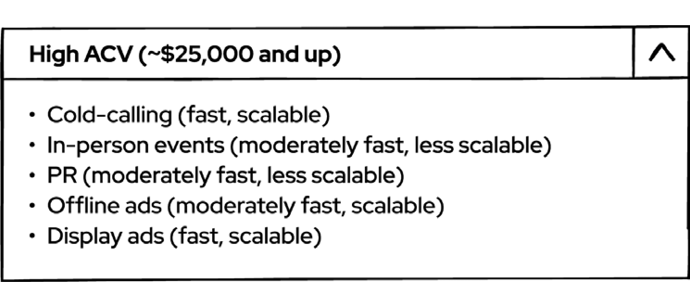
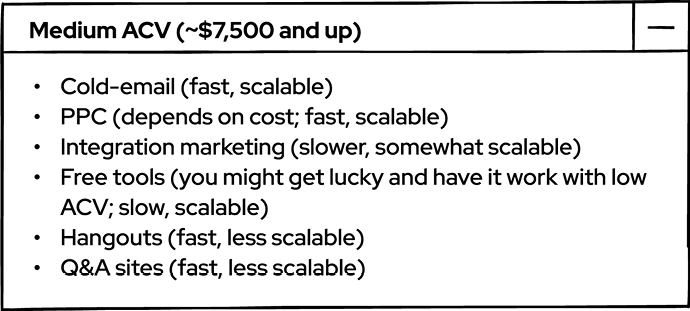
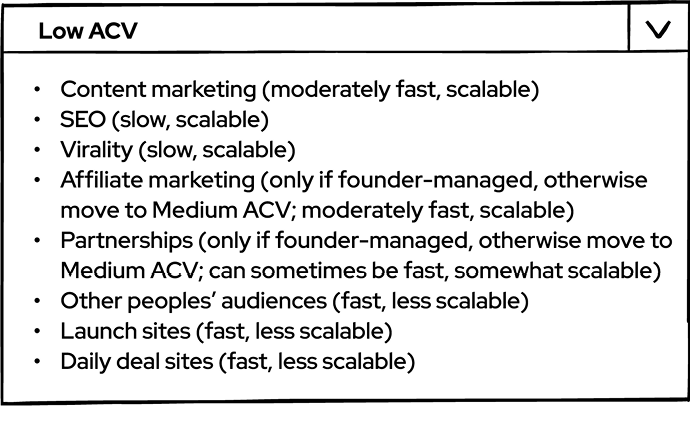
It’s challenging to create a concrete list of which approaches work best at what price point because many of the costs vary widely depending on the space you’re in, whether the founder is running the effort, or whether you’re trying to hire outside staff to assist. But I’ve put together this list to serve as a starting point.
Note that any approach listed as a fit for a particular ACV can also be used in the higher ACV tiers.
Prioritizing Marketing Approaches
Once you’ve narrowed down your list of potential approaches, you can use any prioritization framework to sort them. I’ve found the ICE framework helpful for this purpose. ICE stands for:
- Impact: If this works, how big will the potential impact be?
- Confidence: How likely is this to succeed?
- Ease of implementation: How easy is this to execute?
ICE is often used to prioritize feature development, but it’s also a good tool for prioritizing marketing.
To do this, list potential approaches in a spreadsheet and rate them on a scale of one through 10 for each of the above characteristics. I’ve seen people use several methods to get the score.
- Score = Impact x Confidence x Ease: This gives you a score with an exponential impact. In other words, the higher you rate any one area, the more confident you need to be.
- Score = (Impact + Confidence + Ease)/3: This gives you an average of these three scores.
However you rank those facets, using the ICE framework is a way to get your approaches into a spreadsheet and figure out which are the best to start with. You can list things by high-level approaches (content marketing, PPC) or by individual tactics (ebook, blog post, guest posting, YouTube ads, Facebook ads).
You can also start by ranking high-level approaches, then start a new tab in the spreadsheet to break down the top approaches by individual tactics. Then tackle the highest-rated approaches and tactics first.
Tips for Running Marketing Experiments
Once you have prioritized the marketing approaches that best fit your company, it’s time to put them into practice. Every change you try in your marketing strategy will be experimental until you verify that it delivers the results you are aiming for. Before you start running your first experiment, keep these three tips in mind.
Keep a Marketing Changelog. I recommend keeping a marketing changelog, a chronological record of everything you try, even small things like updating marketing copy on your website. At some point in the future, if you realize trial conversions dropped 14 days ago, you can refer back to your changelog to see how you broke it.
Measure. One mistake I see founders make at this stage is that they don’t measure the effectiveness of each channel. They buy ads but don’t track how much it costs to acquire each new customer based on that ad. They do SEO but don’t attribute where the traffic is coming from.
Track as you experiment, and don’t rely on your gut instinct of whether a marketing approach is working.
You’ll want to track your cost (in dollars and time) and the results. Compare the results of each marketing approach with your initial rating in the ICE framework. How close were you in your original estimation? What assumptions did you start with, and how correct were they? What issues did you uncover? What did you learn?
This data will help you hone your founder gut when choosing your next marketing approaches and tactics with the ICE framework.
Don’t Try Too Much at Once. The approaches that are best suited for your business will vary, but there is one thing that tends to work well: doubling down on a successful approach rather than spreading your energy all over the place.
You don’t need to try dozens of marketing approaches. I’ve seen SaaS companies grow to seven and eight figures by picking just one or two marketing channels and scaling them well, whether that’s content marketing, SEO, integration marketing, PPC, display, outbound, or something else.
You want to start by testing one approach that works quickly (e.g., cold outreach) and one that works slowly (e.g., Google SEO). Assuming you have the resources to tackle both, this allows for short-term and long-term growth. Obviously, the more resources you have, the faster you can move.
Getting a Head Start On Marketing Experiments
Solving the puzzle of how to reach your audience can be tough if you’re a trailblazer. But if you’re fighting for the attention of a defined audience in an established market, here’s a way to get a head start: Talk to the people who are already marketing to them.
If you’ve built a tool for developers, you can take a look at other tools your audience would likely use. If they’re not direct competitors, contact the founder and ask for a quick call. Say, “I know you market to developers. Could you spend 30 minutes chatting with me about what’s working for you?”
Obviously, if they’re a competitor they’re not going to tell you their marketing secrets. But I’ve found that if they have a complementary or unrelated tool, they’re often happy to help. That conversation might even turn into a partnership later.
You can also learn from your competitors. Watch how they’re talking to your shared audience (with the caveat that just because they’re marketing a certain way doesn’t mean they know what they’re doing).
You can also talk to their past employees to get the inside scoop. I’ve reached out to former employees of competitors on LinkedIn to say, “I’ve built a competitor to your former employer, and I’d love to chat about what’s working in our industry when it comes to marketing.” I make it clear they don’t have to tell me any secrets they don’t feel comfortable sharing, and I’ve even offered to pay them for their time.
Salespeople especially love to network—and talk. They’re often a fount of knowledge about what sales brochures look like, how the marketing team works, and what your audience is looking for.
A final approach is to interview your competitors’ founders and marketers. It’s surprising how much you can learn by listening to a founder talk through their approach on a podcast.
Scaling Marketing the Smart Way
One of the biggest mistakes I see venture-funded companies make is raising buckets of money, then dumping it into marketing before they have product-market fit. They’re driving a bunch of people to a product that few want or are willing to pay for.
It’s not sustainable, and good marketing only makes a suboptimal product fail faster.
If you’re a bootstrapper, you can’t afford to make this mistake. Before you start pouring money into finding more leads, you’ll want to do three things:
- Make sure you have reasonably strong product-market fit.
- Make sure your conversion, churn, and other bottom-of-the-funnel numbers are good.
- Experiment to find the most effective marketing approach for your product.
What about Word Of Mouth Marketing?
You might have noticed that I left a big marketing channel off the above list: word of mouth.
Whenever I ask an entrepreneur where most of their leads are coming from and they say word of mouth, I like to keep digging. Usually, the real answer is that they don’t know where customers are coming from.
Which is pretty dang risky.
Word of mouth comes when you start to have an identifiable brand—which generally happens once you get to about seven figures of revenue. You’ll know you’re there when the conversation moves from people talking about “marketing automation” to mentioning two or three players in the space, and you are one of them.
With my SaaS company, Drip, we had excellent word of mouth, but I could see what percentage of our new users came from integrations, organic search traffic, podcasts, and other channels. With Drip, as far as we could tell, word of mouth drove 15% to 25% of new users.
The takeaway is that word of mouth does not account for as much as you think it does—which means you need to get to work figuring out where your traffic is actually coming from.
If you don’t know where your customers are coming from, how can you find more of them? How can you figure out which of your marketing experiments are working? How can you dial in your marketing budget better? How can you know which levers to move to scale your business?
It’s easy to figure out where people from your PPC ads and SEO are coming from. It’s much harder to figure out where direct traffic is coming from. You might have gone on a podcast and mentioned the URL. Someone might have read about it in a book, newspaper, or magazine. They might be on a different device than the one on which they originally heard about your product, so the referral link is cleared. This could be a returning visit.
You’re not going to be able to attribute 100% of traffic, but you should try; any attribution is better than none. One simple approach is to ask customers how they first heard about you or ask where they heard about you right before they signed up. Both data points are helpful.
Another clever approach is the approach Ruben Gamez, founder of SignWell, takes. He told me, “When someone first visits your website, set a cookie with their referral source and another for the landing page. Then save those to your database when they sign up. You can also send them to Stripe, ChartMogul, Mixpanel, etc. for easy segmenting in those tools.”