How Much Should I Worry about Churn?
Churn is the death of SaaS. I’ve seen multimillion-dollar acquisitions fall apart because of high churn.
In your company’s early days, the actual number of churning customers doesn’t matter much because your numbers are too small to be meaningful. If you have $1,000 in MRR and one customer paying you $200 cancels, that’s 20% churn. Normally, I would consider that business-on-fire level—but in this case, it’s just a single customer.
When you see a company with high churn, it’s a sign something’s not working. The product isn’t where it needs to be, they’re solving a problem no one needs solved, or they’re getting the wrong customers through the door. At that point, they should be trying to refine product-market fit.
Until you have product-market fit, you should worry much more about why people are churning than the actual churn number. Of course, low churn is always better. But throwing churn-reducing tactics at your customers when you haven’t built something people want and are willing to pay for can mask your lack of product-market fit.
There are many ways to game churn, like making people email you to cancel or moving to annual only, but those often hide the real reason people are churning, especially early on. The approach at this stage is to find out why people are churning and use that knowledge to refine your product-market fit.
Once you have decent product-market fit, your churn rate becomes highly relevant because it’s how you know when you’re going to plateau, and it’s part of your LTV calculation, which is one indication of the strength of your business. Reducing churn is a critical part of keeping your business strong.
Generally speaking, the lower your product’s price point, the higher your churn. Some of the TinySeed companies that cater to hobbyists or very small businesses have churn in the 5% range, and while I’d love to see churn lower than that, it’s okay because they are in massive markets and have a very low cost to acquire new customers.
For most companies like the type we’re discussing in this book, I suggest shooting for gross revenue churn as low as possible, certainly under 3% per month. At the venture scale, successful companies have less than 1% gross churn.
Segmenting Churn
If I tell you a product has an average review of 2.5 stars on Amazon of over 1,000 reviews, it probably sounds mediocre.
But if I tell you that it has 500 five-star ratings and 500 one-star ratings, that’s a different story. Half of the product’s users love it, and half are the wrong audience.
It’s the same with churn rate. Saying you have a gross churn rate of 8% doesn’t give you the right information to work with. But once you start looking at the churn rate of specific customer segments, you’ll get a clearer picture of what’s going on.
I like to segment by three things: pricing tiers, marketing channels, and time.
Segmenting by Pricing Tier
One TinySeed company has two pricing tiers: $30 a month and $100 a month. As they worked on their churn, they broke it into segments and found that Segment A ($30 a month or less) had a net churn rate of 11%, which is obviously a big problem.
On the other hand, Segment B ($100 a month or more) had a net churn rate of -4%.

Negative churn? What does that even mean?
Net churn is when you subtract expansion revenue, which is when customers pay you more money when they get more value from your product—usually when an existing customer upgrades to a higher pricing tier.
Your business achieves net negative churn when your expansion revenue outpaces the revenue you lose from churning customers. It can be hard to wrap your head around, but +4% churn means you’re losing 4% of your recurring revenue each month. And -4% churn means you’re gaining 4% of additional recurring revenue each month without adding new customers.
(We cover net negative churn, one of the SaaS Cheat Codes, later in this chapter.)

So for this company, its high-paying customers who make up 80% of their revenue have negative churn. It’s night and day trying to grow a company when you have 11% churn versus 4% net negative churn.
This is the value of segmenting churn instead of viewing it as a single number. It inevitably helps you understand your business better than if you were viewing churn in aggregate.
This company’s numbers aren’t unique. In almost every case, your low-paying customers will churn faster and your high-paying customers will be stickier.
Is the answer in this case to cut your lowest pricing tier? It depends. If your lower tier allows people to try out your product and you’re seeing a decent amount of conversion from that tier to a higher one, it might be worth dealing with the high churn rate. Especially if the lower tier doesn’t require a lot of expensive support or onboarding.
However, it could also be that your lowest tier is attracting a segment of customers who aren’t as good a fit for your product as the higher-tier customers. You’ll have to do some more digging to find out.
Segmenting by Marketing Channel
Seeing churn based on marketing channel is an advanced approach, but the results can be eye-opening. It allows you to see which of your marketing channels (or salespeople) are driving long-term growth and which are increasing sign-ups that churn quickly.
As Aaron Kassover, founder of AgentMethods, told me: “Segmenting churn by acquisition channel has been really helpful for us. Learning that the LTV of a pay-per-click lead is way lower than average saved us from wasting a lot of money.”
Unfortunately, doing this requires some setup. In AgentMethods, they track it in ChartMogul by sending attribution data as a custom attribute they filter against.
As Aaron explained, “Besides any UTM data, we also send things like sales rep, onboarding rep, [and] NPS score. It’s really interesting to see how metrics like churn and ARPA vary by salesperson.”
You could roll your own solution to this, but taking developer time away from your product is a foolish decision in my opinion. I would recommend Aaron’s approach or using a tool like SegMetrics (built to solve this problem) or Mixpanel to allow you to segment your churn by marketing channel.
Segmenting by Cohort
Another interesting way to segment churn is by time-based cohort. The easiest way to do this is by setting up a retention grid, which sorts customers based on their tenure with your company and their paying relationship. Some SaaS metrics providers offer this out of the box.
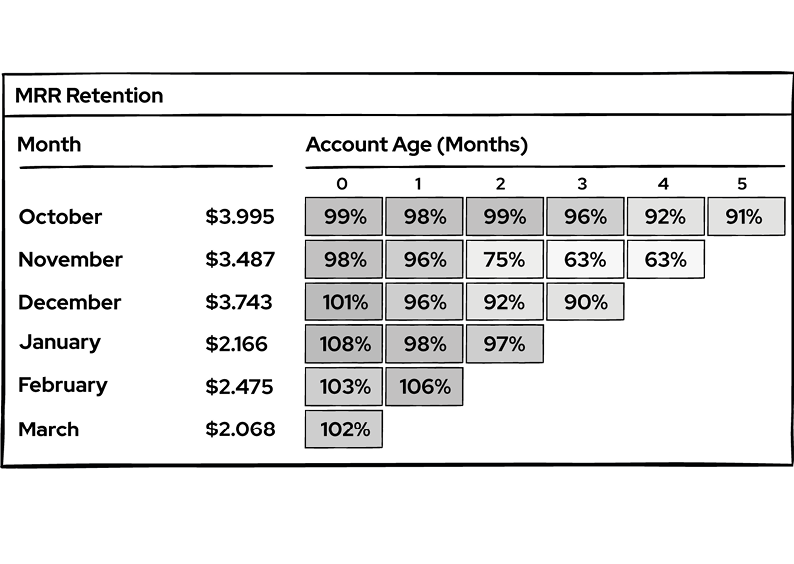
You’ll often see that churn is significantly higher in the first one to two months of a customer’s lifetime because people use that time as an extended paid trial—they are basically sticking around because they haven’t yet set up their account, but they intend to.
This is helpful because if you have massive churn in the first 60 days, you can hypothesize that this is due to people not setting up their accounts or not seeing value in the product. But churn after that will often have a different cause.
To figure out why people are churning in the first few months, ask yourself:
- Is it taking too long for customers to find value?
- Are they finding that the product doesn’t actually meet their needs?
You can nudge both of these in your favor.
It’s Taking Customers Too Long to Find Value. If customers aren’t seeing value in your product, it could be a matter of education. The standard approaches are to send onboarding emails to orient them to your product (see Val Geisler’s Dinner Party Strategy) and to hire a customer success manager to walk new accounts through the onboarding process (assuming their price point makes this worthwhile).
When you have a high price point, hiring someone to help with onboarding can go a long way toward helping your customer find value.
Essentially, you’re trying to help new customers find your minimum path to awesome (MPA). Basically, the moment when everything clicks and your customer says, “This is amazing!”
For a social media scheduling app, maybe it’s when they load the first few posts and realize they can sit back and let your product take care of the rest. For an email product, it could be the minute they get a form installed on their website and start seeing new subscribers.
It’s not always easy to find the MPA. Your product might be so complicated that there are many paths to seeing value.
In that case, the burden is on you to educate your customers about how to get the most value in the shortest amount of time. One way to shortcut the process is to interview customers who are actively using the product and ask them when they first realized how your product would help them.
With Drip, we even built a custom internal dashboard to track where trial users were along the path to awesome. Had they created their first email list? Installed a form on their site? Activated that form?
I could watch individuals or groups of users go through those steps during the trial phase and see a leading indicator of how many were likely to convert into paying customers.
Customers Are Realizing Your Product Doesn’t Meet Their Needs. Sometimes this is a messaging issue. Somehow customers have unrealistic expectations about what your product will do for them, and it’s not until they spend some time using your product that they realize it’s not a good fit.
In this case, it’s helpful to look at new customers by industry and traffic source to see if there are patterns related to how they found you or what they are trying to accomplish with your tool.
Are you overselling your product’s capabilities to an audience looking for more sophisticated solutions? Is your messaging attracting a type of business (e.g., size, vertical) that isn’t a good fit?
One way to answer the above questions is to simply ask.
There are many ways to ask customers why they churn. At Drip, any customer that canceled their account received an automated email within ten minutes of canceling. It said, “Hello, I’m one of the founders of Drip, and I’d love to hear why you decided to cancel your account.”
We got a wide range of responses. Some people would tell us they were shutting their business down—which isn’t something we could fix. Others would say they switched to a cheaper tool because they didn’t need our more powerful product. Others switched to a competitor because they needed a feature we didn’t have.
The key to getting useful data points out of an exit survey is to keep it short and direct, create a connection (“I’m the founder, and your feedback would help me build a better product!”), and ask for a reply—even if it’s just four or five words.
This can give you a glimpse into what potential customers want, which helps guide product decisions.
More often than not, you can get a quick win with churn using tactics like an email welcome sequence and in-app onboarding tools to make sure new users see value early. However, pushing churn below 2% or 3% is a long road that unfolds slowly as you refine your marketing and sales language, learn more about your ideal customer, and add more features those customers love (we covered that in the Market chapter).
If you reduce churn enough, you might find yourself unlocking the SaaS Cheat Code: Net Negative Churn.