How Should I Structure My Pricing?
Pricing is the biggest lever in SaaS, and almost no one gets it right out of the gate.
Fortunately, you don’t need a PhD to structure your pricing well. Like most things in SaaS, finding the right pricing structure is one part theory, one part experimentation, and one part founder intuition.
I wish I could tell you a single “correct” structure, but it varies based on your customer base, the value provided, and the competitive landscape.
Most founders price their product too low or create confusing tiers that don’t align with the value a customer receives from the product.
On the low end, if you have a product aimed at consumers, you can get away with charging $10 to $15 a month. The problem is at that price point, you’re going to be dealing with high churn, and you won’t have much budget to acquire customers.
That can be brutal, but if you have a no-touch sign-up process with a product that sells itself, you can get away with it. Castos’s podcasting software and Snappa’s quick graphic design software are good examples of products that do well with a low average revenue per account (ARPA).
You’ll have more breathing room (and less churn) if you aim for an ARPA of $50 a month or more. In niche markets—or where a demo is required or sales cycles are longer—aim higher (e.g., $250 a month and up).
If you have a high-touch sales process that involves multiple calls, you need to charge enough to justify the cost of selling it. For example, $1,000 a month and up is a reasonable place to start.
If you’re making true enterprise sales that require multiple demos and a procurement process, aim for $30,000 a year and up (into six figures).
One of the best signals to guide your pricing is other SaaS tools, and I don’t just mean competition. Any SaaS tool a company in your space might replace you with, a complementary tool or a tool similar to yours in a different vertical can offer guidance, but make sure you don’t just compare features; compare how it’s sold.
As mentioned above, the sales process has tremendous influence over how a product should be priced.
There are so many SaaS tools out now that a survey of competitive and adjacent tools can give you a mental map of the range of prices you can charge.
No matter where your business sits, one thing is true: “If no one’s complaining about your price, you’re probably priced too low.”
Segmenting Your Customers
The first step to structuring pricing tiers is to segment your customers. You need to figure out who’s using your product, how they’re using it, and what value they’re getting from it.
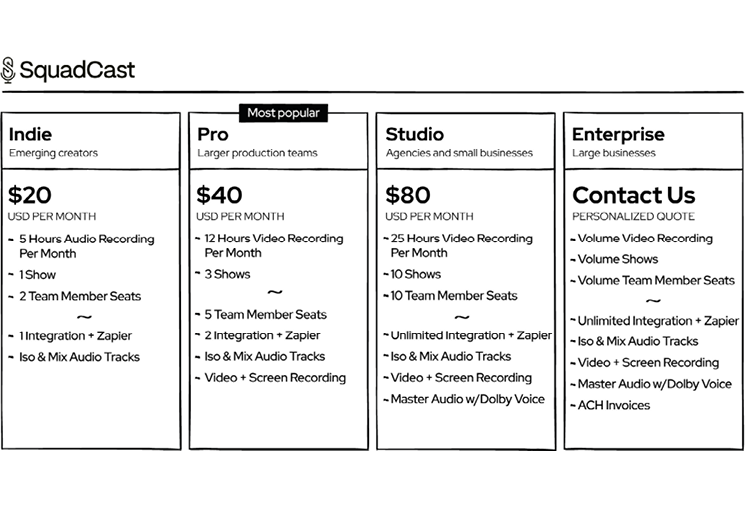
For example, I use a company called SquadCast to record interviews for my podcast (disclosure: I’m also an investor). SquadCast users come in all sizes, and each segment has a range of needs and price sensitivities.
You can imagine a hobbyist podcast aimed at fly-fishers or gamers would pay $10 or $15 a month but not much more. This person would have a consumer mindset.
In the middle of the market, a podcast like mine that’s aimed at the entrepreneur audience will probably be okay paying $50 to $100 a month because it’ll get at least that much value out of its show.
At the top end of the spectrum, you can imagine large podcast networks like NPR or I Heart Radio have much larger budgets to spend on recording—and they also have very different needs than a hobbyist or mid-market show. They’ll be happy to pay 20 times more than the base plan because of the sheer value they’ll get from the product.
SquadCast’s tiers reflect this by scaling up the usage and features they offer in each subsequent tier.
When you segment your customers by size and usage, you start to
see how your pricing tiers work to offer the most value to
customers while driving growth for your business. Getting
pricing tiers right also allows you to tap into the SaaS Cheat
Code we’ve already alluded to: expansion revenue.