The Underlying Structure of Discovery
Back in 2016, I was coaching a product trio who were learning to adopt a continuous cadence for the first time. One day they told me, “Teresa, we are learning a lot of discovery tactics, but we have no idea what to do when. You always tell us our next steps. How are we supposed to do this on our own?” This question floored me. The last thing I wanted was to create a dependency on me. But I didn’t have an easy answer for them. How did I decide what to do next in discovery?
After some reflection7, I realized there’s an underlying structure to discovery that we can use to guide our work. It starts with defining a clear outcome—one that sets the scope for discovery. From there, we must discover and map out the opportunity space—this is what gives structure to the ill-structured problem of reaching our desired outcome. It’s the all-important problem framing that opens up the solution space. And finally, we need to discover the solutions that will address those opportunities and thus drive our desired outcome.
It sounds simple, but this structure helps us know what to do when. I encourage teams to visualize it using an opportunity solution tree (OST).
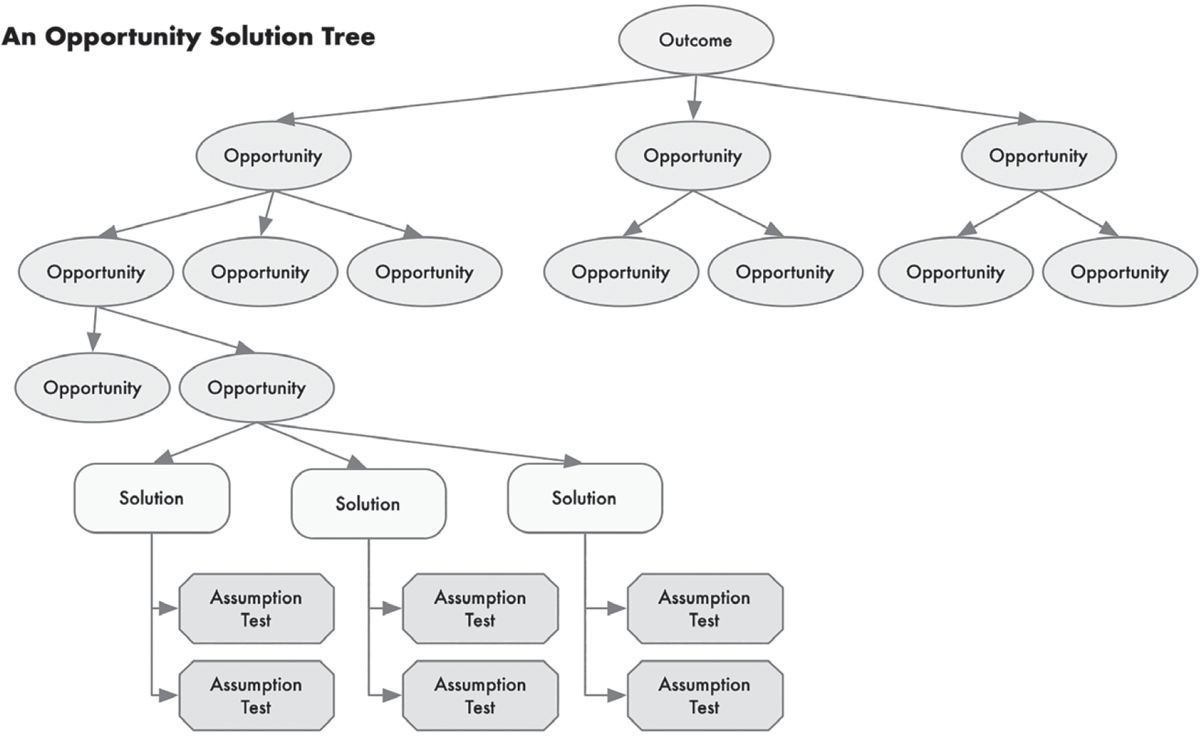
Opportunity solution trees are a simple way of visually representing the paths you might take to reach a desired outcome.
The root of the tree is your desired outcome—the business need that reflects how your team can create business value.
Next is the opportunity space. These are the customer needs, pain points, and desires that, if addressed, will drive your desired outcome.
Below the opportunity space is the solution space. This is where we’ll visually depict the solutions we are exploring.
Below the solution space are assumption tests. This is how we’ll evaluate which solutions will help us best create customer value in a way that drives business value.
Opportunity solution trees have a number of benefits. They help product trios:
- Resolve the tension between business needs and customer needs
- Build and maintain a shared understanding of how they might reach their desired outcome
- Adopt a continuous mindset
- Unlock better decision-making
- Unlock faster learning cycles
- Build confidence in knowing what to do next
- Unlock simpler stakeholder management
We’ll explore each of these benefits throughout this chapter.