Experience Maps Are Visual, Not Verbal
Many of us stopped drawing sometime in elementary school. As a result, we have the drawing skills of a child. This makes drawing uncomfortable. Regardless of how well you draw, drawing is a critical thinking aid that you will want to tap into. Drawing allows us to externalize our thinking, which, in turn, helps us examine that thinking. When we draw an experience map, rather than verbalize it, it’s easier to see gaps in our thinking, to catch what’s missing, and to correct what’s not quite right.20
If you are feeling intimidated by the idea of drawing an experience map, don’t worry. You don’t need to draw well. You can draw boxes and arrows, stick figures, and squiggly shapes that mean something only to you. The goal is not to create a piece of art but rather to visualize your thinking so that you can examine it.
Start with the scope of your experience map. Our product trio that opened the chapter started with the question, “What’s preventing our customers from completing the application today?” In our streaming-entertainment example, we might start with the question, “How do consumers entertain themselves with video?”
When thinking about this question, don’t focus on your product. Instead, draw the experience of your customer. For example, our product trio didn’t draw a screen-by-screen wireflow of their application process. Instead, they drew the process as their customers perceived it. They captured where they got stuck, what went wrong, how they course-corrected, and where they eventually abandoned the process.
In our streaming-entertainment example, we don’t want to draw a screen-by-screen flow of how to use Netflix. Instead, we want to think about the broader context. When and where does video play a role in a user’s life? How do they hear about content? How do they make decisions about what to do when? Who do they do it with? What challenges and obstacles do they face along the way?
The following is a simple experience map that might address the question, “How do customers entertain themselves with videos?” It starts with how someone might hear about content, who they share it with, the need to search for it, the challenges that might arise from trying to find it, the viewing experience, and, ultimately, success. As we learn about our customers, we’ll add far more detail to the map, including the myriad of ways people hear about content, the different services they might have to bounce between, the different devices they watch on, and so much more.
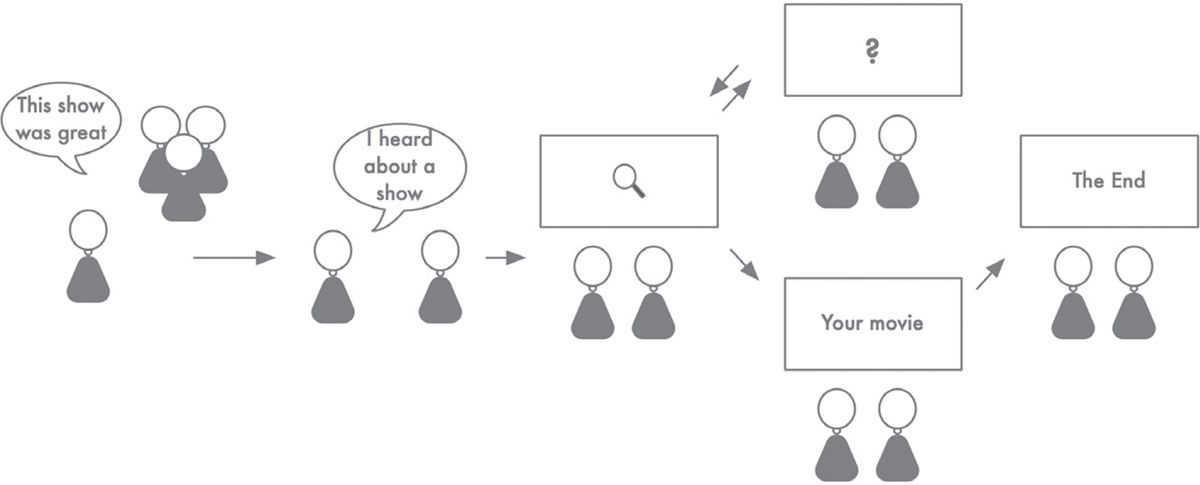
As you get started, you are going to be tempted to describe this context with words. Don’t. Language is vague. It’s easy for two people to think they are in agreement over the course of a conversation, but, still, each might walk away with a different perspective. Drawing is more specific. It forces you to be concrete. You can’t draw something specific if you haven’t taken the time to get clear on what those specifics are. Your goal during this exercise is to do the work to understand what you know, not to generalize vague thoughts about your customer. So set aside some time, grab a pen and paper, and start drawing. Push through the discomfort of being a beginner, and you’ll be reaping the benefits in no time.
Once each member of your trio has taken the time to inventory what they know, it’s time to explore the diverse perspectives on your team.