OSTs Unlock Better Decision-Making
As product trios explore the best path to their desired outcome, they need to make key decisions along the way. It’s easy to get lost. When you bounce from tactic to tactic, it’s easy to forget what you’ve learned and what decisions you need to make next.
Chip and Dan Heath, in their book Decisive, outline four villains of decision-making that lead to poor decisions. The first villain is looking too narrowly at a problem. This is exactly why we want to explore multiple ways of framing the opportunity space. The second villain is looking for evidence that confirms our beliefs. This is commonly known as confirmation bias. We’ll be discussing this bias often throughout the book. We’ll be exploring several habits that will help us overcome this bias and ensure that we are considering both confirming and disconfirming evidence. The third villain is letting our short-term emotions affect our decisions. In the product world, this often shows up when we fall in love with our ideas. The fourth villain is overconfidence. This, too, is common in the product world. We are often sure our ideas will be runaway successes.
In Decisive, the Heath brothers outline many tactics for overcoming the four villains of decision-making, which is why it is the first book (after this one) that I recommend all product managers read. But the one tactic we’ll rely on over and over again throughout this book is their advice to avoid “whether or not” decisions. A “whether or not” decision is when we frame a problem as “Should we do this or not?” Product trios get caught up in “whether or not” decisions when we react to one customer need or pain point at a time, asking, “Should we stop everything and fix this problem?” We also encounter “whether or not” decisions when a stakeholder asks us to implement their pet feature, and we ask, “Should we stop everything and build this feature?” This is perhaps the most common mistake product trios make.
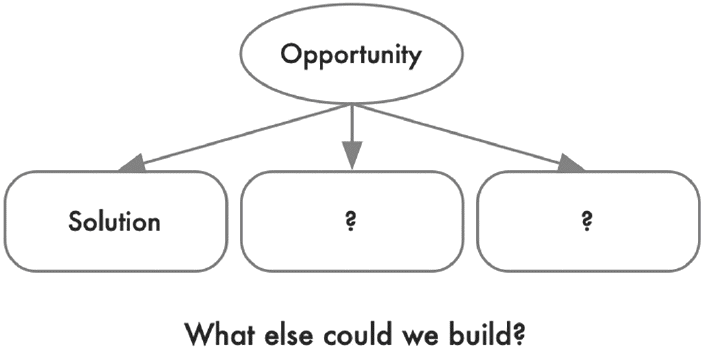
Instead of framing our decisions as “whether or not” decisions, this book will teach you to develop a “compare and contrast” mindset. Instead of asking, “Should we solve this customer need?” we’ll ask, “Which of these customer needs is most important for us to address right now?” We’ll compare and contrast our options. Instead of falling in love with our first idea, we’ll ask, “What else could we build?” or “How else might we address this opportunity?” Visualizing your options on an opportunity solution tree will help you catch when you are asking a “whether or not” question and will encourage you, instead, to shift to a compare-and-contrast question.
Even with this decision-making framework in hand, you’ll still need to guard against overconfidence (the fourth villain of decision-making). It’s easy to think that, when you’ve done discovery well, you can’t fail, but that’s simply not true (as we’ll see in a few stories throughout this book). Good discovery doesn’t prevent us from failing; it simply reduces the chance of failures. Failures will still happen. However, we can’t be afraid of failure. Product trios need to move forward and act on what they know today, while also being prepared to be wrong. The habits in this book will help you balance having confidence in what you know with doubting what you know, so that you can take action while still recognizing when you are on a risky path.8
And finally, we can’t talk about decision-making without tackling the dreaded problem of analysis paralysis. Many of the decisions we make in discovery feel like big strategic decisions. That’s because they often are. Deciding what to build has a big impact on our company strategy, on our success as a product team, and on our customers’ lives. However, most of the decisions that we make in discovery are reversible decisions. If we do the necessary work to test our decisions, we can quickly correct course when we find that we made the wrong decision. This gives us the luxury of moving quickly, rather than falling prey to analysis paralysis. The habits in this book will teach you how to make fast decisions and then quickly test to understand the consequences of those decisions. You’ll learn to adapt as you go rather than slow down to analyze.
Visualizing each decision point and the options that you considered on the opportunity solution tree will help you revisit past decisions when needed and will give you the context you need to course-correct.