Exploring Different Types of Outcomes
Managing by outcomes is only as effective as the outcomes themselves. If we choose the wrong outcomes, we’ll still get the wrong results. When considering outcomes for specific teams, it helps to distinguish between business outcomes, product outcomes, and traction metrics. A business outcome measures how well the business is progressing. A product outcome measures how well the product is moving the business forward. A traction metric measures usage of a specific feature or workflow in the product.
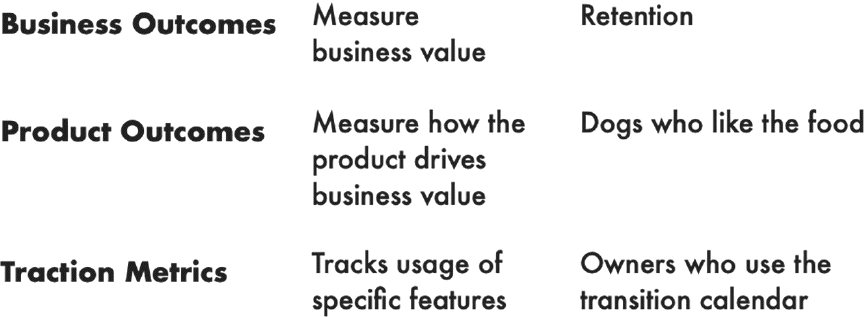
Business outcomes start with financial metrics (e.g., grow revenue, reduce costs), but they can also represent strategic initiatives (e.g., grow market share in a specific region, increase sales to a new customer segment). Many business outcomes, however, are lagging indicators. They measure something after it has happened. It’s hard for lagging indicators to guide a team’s work because it puts them in react mode, rather than empowers them to proactively drive results. For Sonja’s team, 90-day retention was a lagging indicator of customer satisfaction with the service. By the time the team was able to measure the impact of their product changes, customers had already churned. Therefore, we want to identify leading indicators that predict the direction of the lagging indicator. Sonja’s team believed that increasing the perceived value of tailor-made dog food and increasing the number of dogs who liked the food were leading indicators of customer retention. Assigning a team a leading indicator is always better than assigning a lagging indicator.
As a general rule, product trios will make more progress on a product outcome rather than a business outcome. Remember, product outcomes measure how well the product moves the business forward. By definition, a product outcome is within the product trio’s span of control. Business outcomes, on the other hand, often require coordination across many business functions. For example, suppose Sonja’s team discovered that, in addition to some customers not understanding the value of tailor-made dog food and some dogs not liking the food, poor customer-support response times and surprise price increases that occurred after their trial period ended also influenced their high churn rate. In this case, product, marketing, and customer support might need to coordinate their efforts to increase retention.
Coordination isn’t bad. In fact, most of the work that we do will require coordination across teams. However, we can increase the accountability of each team by assigning a metric that is relevant to their own work. In this example, we might ask the product team to increase the number of dogs who like the food (something within the product team’s span of control), whereas we might ask the marketing team to increase the transparency of the pricing after the trial ends, and we might ask the customer-support team to decrease their average response times. All three groups are contributing to the business outcome of increasing customer retention, but each is doing so in the way that they can best contribute.
Assigning product outcomes to product trios increases a sense of responsibility and ownership. If a product team is assigned a business outcome, it’s easy for the trio to blame the marketing or customer-support team for not hitting their goal. However, if they are assigned a product outcome, they alone are responsible for driving results. When multiple teams are assigned the same outcome, it’s easy to shift blame for lack of progress.
Finally, when setting product outcomes, we want to make sure that we are giving the product trio enough latitude to explore. This is where the distinction between product outcomes and traction metrics can be helpful. It’s also a key delineation between an outcome mindset and an output mindset. If Sonja’s team believes more dogs would like the food if their owners had a better transition plan, why not get more specific with the outcome? For example, they could launch a transition calendar and measure engagement with that calendar as their outcome. This strategy, however, assumes that the transition calendar is the right output. If it’s not—if it turns out that customers don’t want to use the transition calendar—then Sonja’s team is stuck. They don’t have the latitude to explore alternative solutions. Even though it looks like they were focused on an outcome (engagement with the transition calendar), they were really fixated on an output (the transition calendar itself).
When we assign traction metrics to product trios, we run the risk of painting them into a corner by limiting the types of decisions that they can make. Product outcomes, generally, give product trios far more latitude to explore and will enable them to make the decisions they need to ultimately drive business outcomes. However, there are two instances in which it is appropriate to assign traction metrics to your team.
First, assign traction metrics to more junior product trios. Improving a traction metric is more of an optimization challenge than a wide-open discovery challenge and is a great way for a junior team to get some experience with discovery methods before giving them more responsibility. For your more mature teams, however, stick with product outcomes.
Second, if you have a mature product and you have a traction metric that you know is critical to your company’s success, it makes sense to assign this traction metric to an optimization team. For example, Sonja’s team may already know that customers want to use the transition calendar—perhaps they use it every day—but the recommended schedule isn’t as effective as they hoped it would be. In this case, it might make sense to have a team focused on optimizing the schedule. If the broader discovery questions have already been answered, then it’s perfectly fine to assign a traction metric to a team. The key is to use traction metrics only when you are optimizing a solution and not when the intent is to discover new solutions. In those instances, a product outcome is a better fit.