Story Map to Get Clarity
It’s hard to enumerate our assumptions if we aren’t specific about what our ideas mean. After ideating, our ideas tend to be vague concepts. You can fit only so many words on a sticky note (virtual or physical). Even if you’ve taken the time to describe your ideas, odds are each person in your trio is interpreting the idea differently. This means that each person is making their own assumptions about how the idea will work. It’s hard to test your underlying assumptions when you don’t yet agree on what those assumptions are.
One of the best ways to align as a team around what your ideas mean is to story map them. Story mapping is a popular technique in which teams map out each step end-users have to take to get value from a product or service.49 Story mapping forces you to get specific about how an idea will work and what you expect your end-users will do. While many teams use story mapping to align around product requirements, it’s also a great technique for helping us to surface underlying assumptions.

To story map your ideas:
Start by assuming the solution already exists. You aren’t story mapping what it will take to implement an idea. Instead, you are mapping what end-users will do to get value from the solution once it exists in the world.
Identify the key actors. Who needs to interact with whom for the idea to work? Some products like Slack or Facebook require that two or more end-users interact with each other for anyone to get value from the product. If this is the case, you’ll want to represent multiple end-users in your story map. In two-sided marketplaces, you might have different types of end-users (e.g., buyers and sellers). In some products or services, the interface or software itself may be an actor in your map (e.g., for an end-user conversing with a chatbot, the chatbot should be listed as a player in the story map).
Map out the steps each actor has to take for anyone to get value from the solution. Be specific. What does each actor need to do in order for someone to get value from the solution? For example, an actor has to engage with a chatbot by asking a question or making a request, the chatbot then needs to respond, and so on.
Sequence the steps horizontally over time. Lay out the steps horizontally one after the other. Sequence them in the order they need to happen. You may need to jump back and forth between players if they need to take turns taking actions. It’s okay if some steps are optional. List them in the map where they might occur. If an end-user can choose multiple paths, map out the successful path. If there are multiple successful paths, map them out sequentially.
Let’s walk through an example. Suppose we are working at our streaming-entertainment company, and we are exploring three different solutions (setting up a good compare-and-contrast decision) for the target opportunity “I want to watch live sports.”
- Integrate local networks (e.g., ABC, CBS, NBC) into our service
- License broadcast rights directly from the different sports leagues and serve the sporting events up ourselves
- Bundle our streaming service with a partner who streams live sports
To story map our first idea—integrating local networks—we need to start by identifying the key players. In this case, it’s easy to make the mistake of thinking our key players are our business-development folks and their equivalent at the respective local channel providers. But remember, with story mapping, we want to assume the solution already exists. We aren’t story mapping what it would take to build the service—we are story mapping what the key players need to do for our consumer to get value from it.
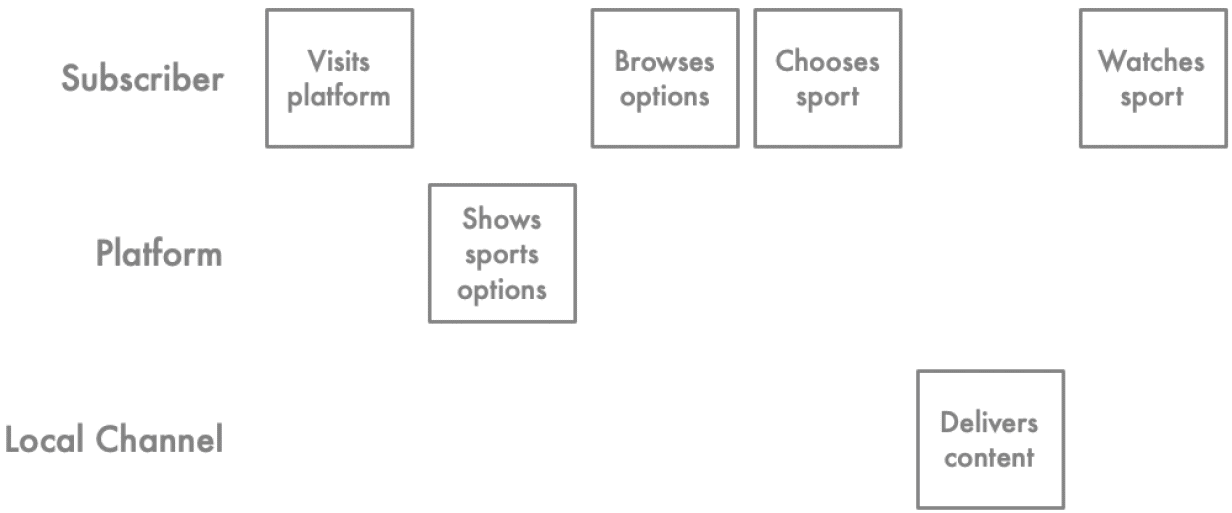
So, in this case, our key players might be the sports consumer (i.e., our subscriber), our streaming platform, and any number of local TV channel partners. Our story map might include the following steps:
- Our subscriber comes to our platform to watch live sports.
- Our platform has live sports options for our subscriber to choose from.
- Our subscriber browses the options and chooses a sport that is currently on a local TV channel.
- Our local channel provider’s content is available to stream.
- Our subscriber watches live sports.
Now, even though this story map is quite simple, we may still need to make some critical decisions along the way. Can we offer the ability to search for a specific sport or a specific sporting event on our platform? In other words, can the local provider share their listings with us in a format that we can integrate into our own search results? Or does the subscriber need to know the game they want to watch is on NBC and they need to search for NBC? We don’t have to know all the answers right now.
Instead, we want to story map what we think would be the best solution based on what we know today. You can see that, in the above map, we assumed that the sports search would happen on the streaming-entertainment platform. We are assuming that’s possible. That’s okay. We have to make assumptions before we can test assumptions. But don’t worry about whether you are getting everything exactly right. We’ll have plenty of time to iterate and refine our ideas as we test our assumptions. This is merely a starting point.