Avoid Common Anti-Patterns
After you’ve created your first draft, keep an eye out for these common anti-patterns.
Opportunities framed from your company’s perspective. Product teams think about their product and business all day every day. It’s easy to get stuck thinking from your company’s perspective rather than your customers’ perspective. However, if we want to be truly human-centered, solving customer needs while creating value for the business, we need to frame opportunities from our customers’ perspective. No customer would ever say, “I wish I had more streaming-entertainment subscriptions.” But they might say, “I want access to more compelling content.” Review each opportunity on your tree and ask, “Have we heard this in interviews?” If you had to add opportunities to support the structure of your tree, you might ask, “Can I imagine a customer saying this?” Or are we just wishing a customer would say this?
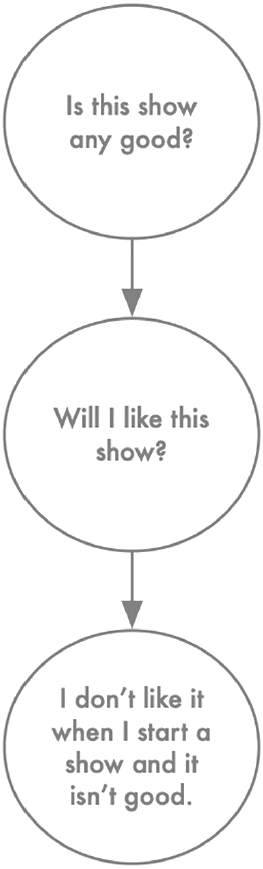
Vertical opportunities. Vertical opportunities are when we have a parent with one child, who, in turn, has only one child, resulting in a vertical stack of single opportunities. Vertical opportunities tend to arise in two situations. One: You hear similar opportunities from several interviews, and each opportunity is really saying the same thing in different words. In this case, simply reframe one opportunity to encompass the broader need, and remove the rest. Otherwise, you’re missing sibling opportunities. If each sub-opportunity only partially solves the parent, then identify which sibling opportunities are missing, and fill them in. If you aren’t sure what the missing opportunities are, explore the parent opportunity in your upcoming interviews.
Opportunities have multiple parent opportunities. If your top-level opportunities represent distinct moments in time, then no opportunity should have two parents. If you are finding that an opportunity should ladder up to more than one parent, it’s framed too broadly. Get more specific. Define one opportunity for each moment in time in which that need, pain point, or desire occurs.
Opportunities are not specific. Opportunities that represent themes, design guidelines, or even sentiment, aren’t specific enough. “I wish this was easy to use,” “This is too hard,” and “I want to do everything on the go” are not good opportunities. However, if we make them more specific, they can become good opportunities: “I wish finding a show to watch was easier,” “Entering a movie title using the remote is hard,” and “I want to watch shows on my train commute” are great opportunities.
Opportunities are solutions in disguise. Often in an interview, your customer will ask for solutions. Sometimes they will even sound like opportunities. For example, you might hear a customer say, “I wish I could fast-forward through commercials.” You might be tempted to capture this as an opportunity. However, this is really a solution request. The easiest way to distinguish between an opportunity and a solution is to ask, “Is there more than one way to address this opportunity?” In this example, the only way to allow people to fast-forward through commercials is to offer a fast-forward solution. This isn’t an opportunity at all. Instead, we want to uncover the implied opportunity. Maybe it’s as simple as, “I don’t like commercials.” Why does this reframing help? If we then ask, “How might we address ‘I don’t like commercials’?” we can generate several options. We can create more entertaining commercials—like those we see during the Super Bowl. We can allow you to fast-forward through commercials like the customer suggested. Or we can offer a commercial-free subscription. An opportunity should have more than one potential solution. Otherwise, it’s simply a solution in disguise.
Capturing feelings as opportunities. When a customer expresses emotion in an interview, it’s usually a strong signal that an opportunity is lurking nearby. However, don’t capture the feeling itself as the opportunity. Instead, look for the cause of the feeling. When we capture opportunities like “I’m frustrated” or “I’m overwhelmed,” we limit how we can help. We can’t fix feelings. But if we capture the cause of those feelings—“I hate typing in my password every time I purchase a show” or “I’m way behind on this show”—we can often identify solutions that address the underlying cause. So, do note when a customer expresses a feeling, but consider it a signpost, and remember to let it direct you to the underlying opportunity.