Add Structure to Each Branch
Now that you’ve collected the relevant opportunities, it’s time to add structure to each branch. Work with one branch at a time. Start by grouping similar opportunities together. Similar opportunities might be siblings, like we saw with “I want to watch my shows on a plane” and “I want to watch my shows on my train commute.” Or they might turn out to be the same opportunity worded slightly differently. For example, “I don’t like entering a show title with my remote control” and “Selecting letters with the keypad is hard.”
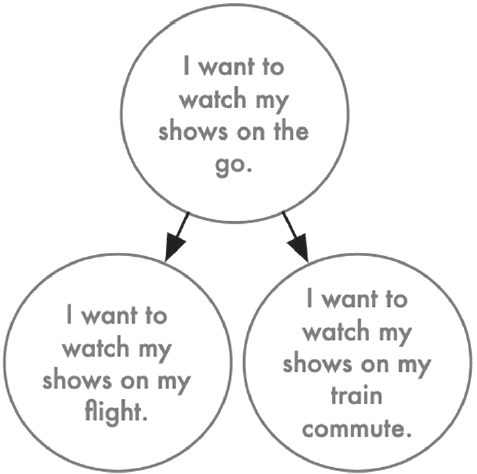
If your similar opportunities are siblings, look for a parent opportunity. In our train/plane example, we identified, “I want to watch my shows on the go” as the parent opportunity. This might have been explicitly mentioned in an interview, in which case, it will already be in our branch. But if it wasn’t, it’s fine to go ahead and add it, as it’s implied by the other two opportunities. So, don’t fret if you need to add parent opportunities that weren’t explicitly stated in an interview.
If your similar opportunities are really the same, like we saw with the two opportunities about entering a show title with a remote, simply combine them into one opportunity. In this case, we might merge them into “Entering a show name into the search box is hard.”
As you start to group siblings together and identify parent opportunities, you’ll end up with a set of mini-trees. Look for sibling relationships between the parents of those mini-trees. Which can you group together? If you need to, add a shared parent to cluster similar opportunities together. Keep iterating through these steps until you’ve identified a set of siblings that ladder up to the top opportunity (i.e., the one that reflects a key moment) from which all other opportunities descend.
Then repeat the whole process for the remaining branches in your tree.