Prioritizing Assumptions
Armed with a long list of assumptions for each idea, it’s now time to assess and prioritize which assumptions need further testing. Assumption mapping, an exercise designed by David J. Bland, author of Testing Business Ideas, is a great way to quickly identify what Bland calls your “leap of faith” assumptions—the assumptions that carry the most risk and thus need to be tested.
With assumption mapping, you’ll be quickly evaluating each assumption on two dimensions. I recommend you start with assessing “How much do we know about this assumption?” In other words, what evidence do we already have that tells us this assumption is true or false? If we have a lot of evidence that it’s true, then we would place the assumption on the left side of the x-axis. If we have very little evidence, we would place it on the right side of the x-axis.
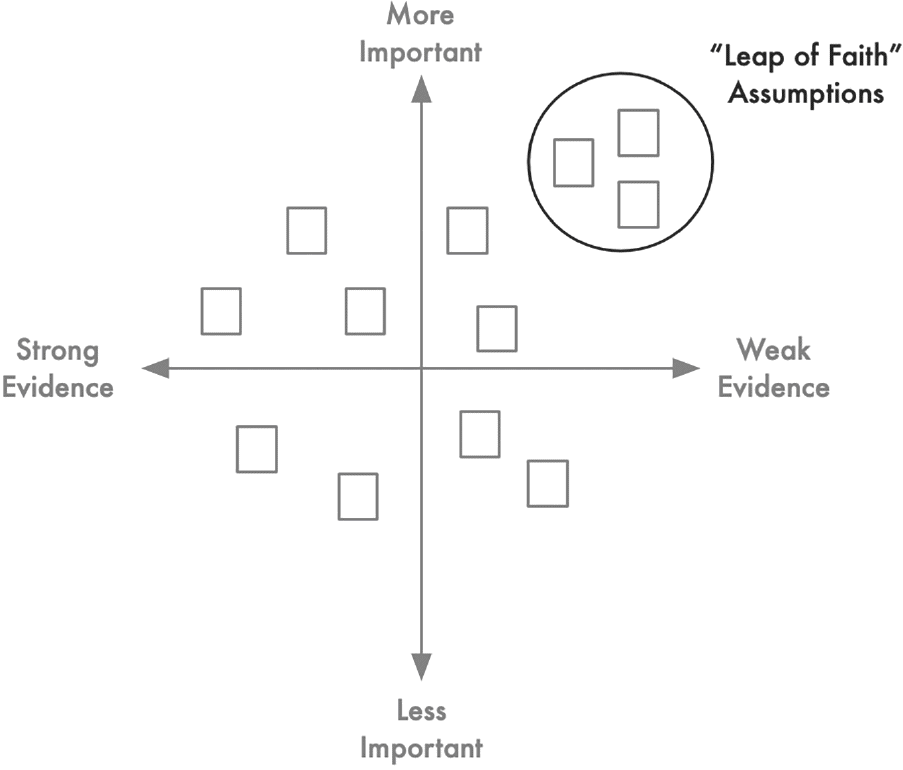
Next, we want to assess how important this assumption is to the success of your idea. Now, all assumptions are important to the success of your idea as currently designed. However, some assumptions can be easily worked around if they turn out not to be true. Others may be much harder to work around. These would make these assumptions more important. The more important an assumption is, the higher on the y-axis it gets placed. The less important it is, the lower on the y-axis it gets placed.
Each assumption lives in one spot on the two-dimensional grid. You want to find the moment in space that represents how important an assumption is to the success of the idea and how much evidence we have or don’t have to support it. However, this exercise does not need to be precise. You are mapping assumptions relative to each other. For example, once you place the first assumption, for the second assumption, you can now ask, “Do we have stronger or weaker evidence for this assumption as compared to the first assumption, and is this assumption more or less important than the first assumption?” and place it relative to the first assumption.
In my experience running this exercise in workshops and with the teams that I coach, teams do just as well when they do this exercise fast (i.e., no more than ten minutes per idea) as when they deliberate and discuss every placement. So, save yourself some time, and go fast.
Additionally, some teams have a bias toward everything being important and having weak evidence. That’s okay. All of your assumptions have some degree of both. Whether your assumptions are all jammed in the upper-right corner or are spread across all four quadrants, it doesn’t matter. What does matter is that your assumptions are positioned relative to each other.
Once we’ve completed our mapping, we are going to start by testing the assumptions in the top-most, right-most corner. Bear in mind, this does not mean you are testing all of the assumptions in the top-right quadrant. We often don’t have time for that. It means you are starting with the two or three assumptions that fall in the upper-right corner. Those are your most important assumptions with the weakest evidence—the assumptions that Bland calls your “leap of faith” assumptions.
You’ll want to story map, generate assumptions, and assumption map for each of your three ideas. In the next chapter, we’ll learn how to quickly test your “leap of faith” assumptions for each of your ideas so that you are able to compare and contrast the ideas against each other.