Using the Tree to Aid Decision Making
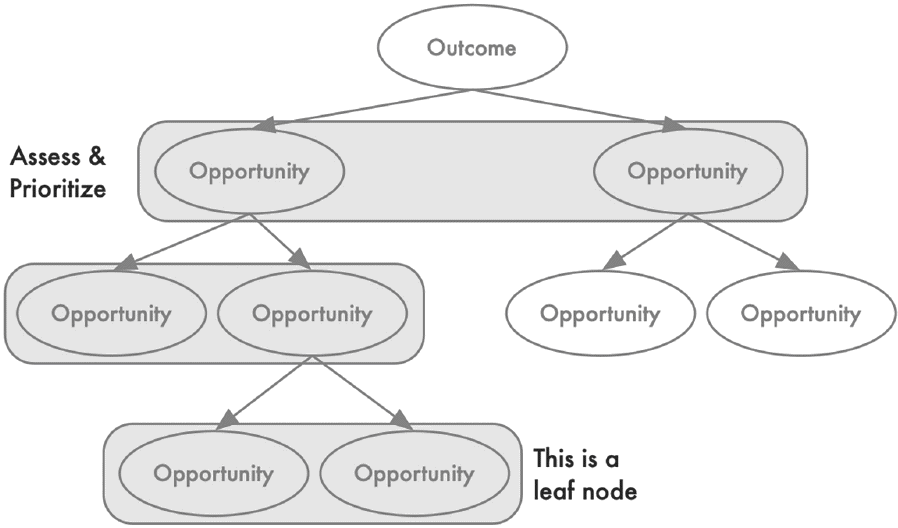
You’ll start by assessing your top-level opportunities—the parent opportunities on your opportunity solution tree. Drawing from what we learned in Chapter 2, you won’t be working with each top-level opportunity in isolation. You don’t want to ask, “Should we pursue this opportunity?” That’s a “whether or not” question that leads to poor decisions. It makes us susceptible to confirmation bias, and we forget to consider opportunity cost. Instead, you’ll compare and contrast the set of parent opportunities against each other.
In the next section, we’ll explore how to best assess sets of opportunities. For now, assume you can identify the highest priority. If your opportunity space is well structured (see Chapter 6), you can now ignore all but this branch of the tree for the rest of your assessment. If your chosen parent is the highest priority, then the highest-impact opportunity to address next will live under that branch.
Notice how a single decision, assessing and prioritizing your top-level opportunities, reduces the amount of assessing you have to do. We can effectively ignore the other branches of our tree and focus on assessing just our target branch. That’s the power of the tree structure.
We’ll now repeat our assessing-and-prioritizing exercise for the children of our primary top-level opportunity. We’ll compare and contrast the children against each other and choose a front runner. If our front runner has children, we’ll repeat the exercise again. We’ll keep iterating until we identify a target opportunity that has no children.
You always want to choose a leaf-node opportunity (i.e., one that has no children) because our goal is to deliver iterative value over time. We can do this by solving a series of smaller opportunities in succession rather than addressing sets of opportunities at once. However, this doesn’t necessarily mean that your target opportunity will be easy to address. It simply means that you haven’t (yet) identified any sub-opportunities that contribute to addressing it.