The Power of Trees
Instead of managing an opportunity backlog, we’ll use an opportunity solution tree (introduced in Chapter 2) to help us map out and understand the opportunity space. The tree structure will help us visualize and understand the complexity of the opportunity space.
Trees depict two key relationships—parent-child relationships and sibling relationships. Both will help us make sense of the messy opportunity space. The parent-child relationship will be used to represent subsets—a child opportunity (or sub-opportunity) is a subset of a parent opportunity. For example, in the previous section, we saw that “I’m out of episodes of my favorite show” was one reason—but not the only reason—for “I can’t find anything to watch.” Referring to the tree relationships, we would say that “I can’t find anything to watch” is the parent of the child “I’m out of episodes of my favorite shows.”
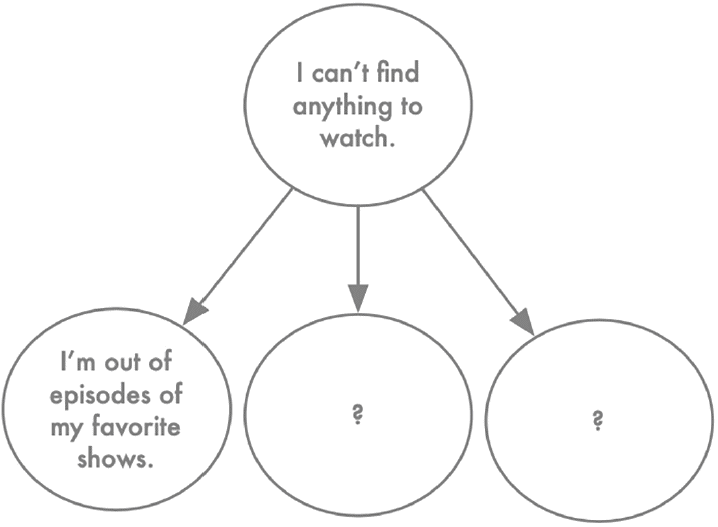
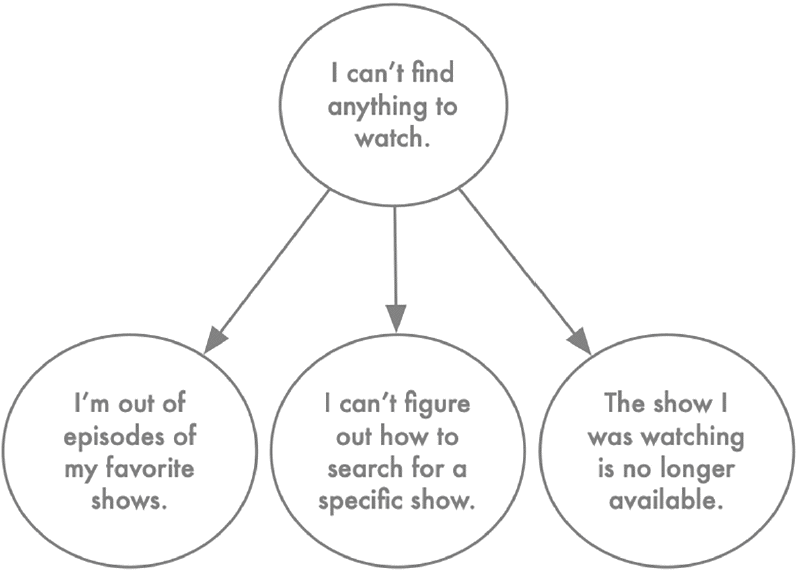
We might then ask, “What are some other reasons our customers say, ‘I can’t find anything to watch’?” We might add, “I can’t figure out how to search for a specific show” and “The show I was watching is no longer available” as siblings to “I’m out of episodes of my favorite shows.” Siblings should be similar to each other—in that they are each a subset of the same parent—but distinct in that you can address one without addressing another. For example, we can address “I can’t figure out how to search for a specific show” without addressing “I’m out of episodes of my favorite shows.” But by addressing “I can’t figure out how to search for a specific show,” we partially address “I can’t find anything to watch.”
Sibling relationships help us make sense of similar opportunities like “I want to watch my shows on my flight” and “I want to watch my shows on my train commute.” We can easily depict both on our tree under the parent opportunity “I want to watch my shows on the go.” This allows us to treat each context (e.g., plane, train) as a specific need to address, while also visualizing the similarities. They are both sub-opportunities of the same parent.
When we learn to think in the structure of trees, it helps us deconstruct large, intractable problems into a series of smaller, more solvable problems. For example, “Is this show any good?” might, on the surface, look like a challenging problem to solve. But as we dig in and learn more, we realize that different people solve this problem in different ways. Some people choose what to watch based on the type of show (e.g., they like dramas or crime shows). Others choose shows based on who is in it—they have favorite actors—and they use the cast list as their primary selection factor. The more we learn about how people evaluate shows today, the more likely we can turn a big, intractable problem like “Is this show any good?” into a series of more solvable problems: “What type of show is this?” “Who is in this show?” “Is this show similar to another show I’ve watched?” “Who else is watching this show?” and so on. The big, intractable problem of “Is this show any good?” is a parent opportunity, while the rest are its sub-opportunities (or children).
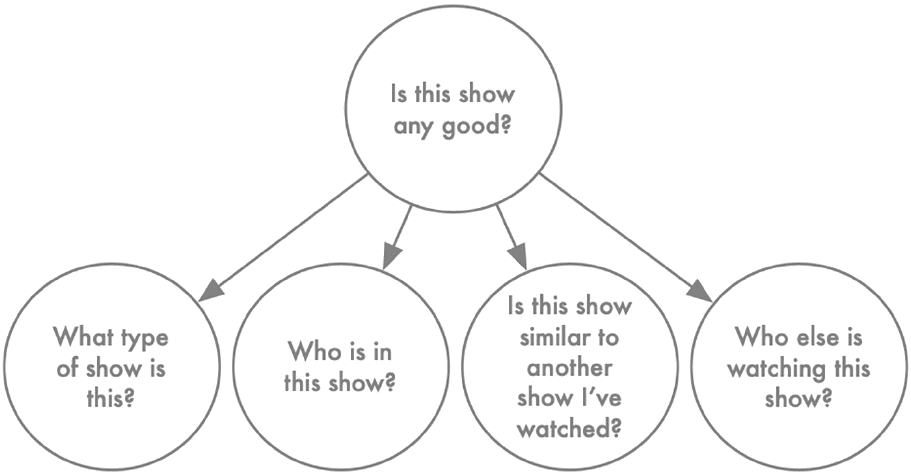
The value of breaking big opportunities into a series of smaller opportunities is twofold. First, it allows us to tackle problems that otherwise might seem unsolvable. And second, it allows us to deliver value over time. That second benefit is at the heart of the Agile manifesto and is a key tenet of continuous improvement. Rather than waiting until we can solve the bigger problem—“Is this show any good?”—we can deliver value iteratively over time. We might start by solving the smaller problem of “Who is in this show?” because it’s fairly easy to solve and because we know a large percentage of our audience chooses shows according to this criterion. This allows us to ship value quickly. Now it might not solve the bigger opportunity completely, but it does solve a smaller need completely. Once we have accomplished that, we can move on to the next small opportunity. Over time, as we continuously ship value, we’ll chip away at the larger opportunity. Eventually, we’ll have solved enough of the smaller opportunities that we will, in turn, have solved the larger opportunity.
Additionally, the tree structure is going to be invaluable when it comes time to assessing and prioritizing opportunities. Our goal is to work on the most impactful opportunity, but we can’t assess every opportunity we come across. We’d spend weeks assessing the opportunity space instead of shipping value to our customers. Instead, we’ll use the tree structure to help us make fast decisions. We’ll learn more about that in the next chapter.
For now, know that, while structuring the opportunity space is hard work, the effort will be paid back with hefty rewards.