Identifying Distinct Branches
To unlock the power of deconstructing big, intractable challenges into a series of more solvable, smaller opportunities, we need a well-structured opportunity space. A key concept that drives this structure is the idea of distinctness. We need each opportunity to be distinct from every other opportunity. If there’s overlap, then we can’t work on one at a time. Instead, they all get enmeshed with each other, and we need to work on all of them at the same time. If this is how you are feeling, it’s a good sign that your tree needs more structure.
Working with product teams, I’ve identified two ways to uncover the underlying structure of your opportunity space. The first is to use the steps of your experience map that you created in Chapter 4. The second is to use your interview drawings to identify key moments in time. Both strategies accomplish the same goal—they help you organize the opportunity space by distinct moments so that there is no overlap from one branch to the next. We’ll dive into both options in more detail here.
In Chapter 4, you learned how to visualize what you already know about your customers’ experience. The output of this exercise was an experience map that showcases what your customers do to address their needs today. You learned that the map can help direct the stories that you collect in your interviews. It can also help give structure to the opportunity space. Our goal is to identify distinct moments in time during your customers’ experience. Oftentimes this is as simple as mapping each node in your experience map to the top level of opportunities on your opportunity solution tree.
However, if your team isn’t starting from a strong understanding of the customer experience, your map may not have distinct moments in time. It needs to evolve before you can identify them. Another approach to uncovering these distinct moments is to analyze the customer stories you are collecting in your interviews. In Chapter 5, I encouraged you to draw the stories that you heard. You do this by identifying the key moments in time that occurred during each story. If you take all of these drawings and start to label each key moment (or node), you’ll notice patterns across your unique stories. What nodes are showing up in story after story? How can you stitch the most common nodes together to create an experience map that represents the set of stories that you are collecting? You can then map these nodes to your top-level opportunities.
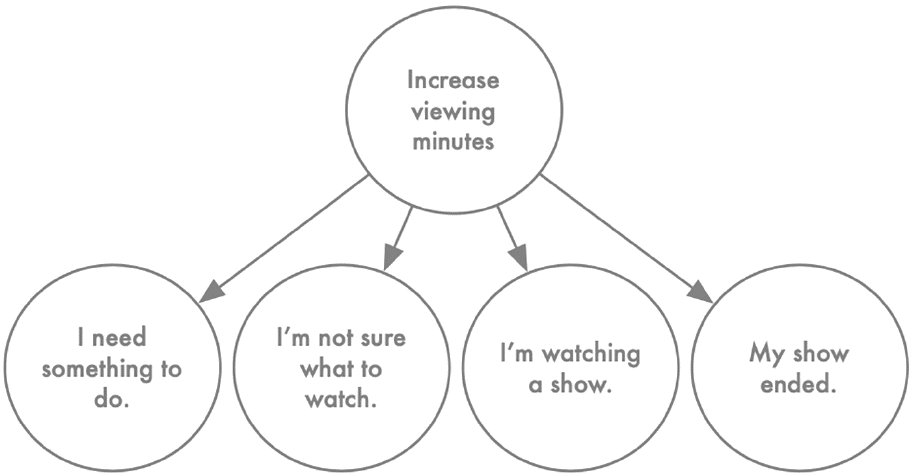
With either strategy, the key is to make sure there is no overlap between the moments in time. Overlap will prevent us from working on one opportunity at a time. If we continue with our streaming-entertainment case study, we might identify the following distinct moments based on our experience map from Chapter 4:
- Deciding to watch something
- Choosing something to watch
- Watching something
- The end of the watching experience
From these distinct moments in time, we could then create the following top-level opportunities: